When Democracy Discovers Its Own Throat: The Perpetual Redefinition of Acceptable Opposition
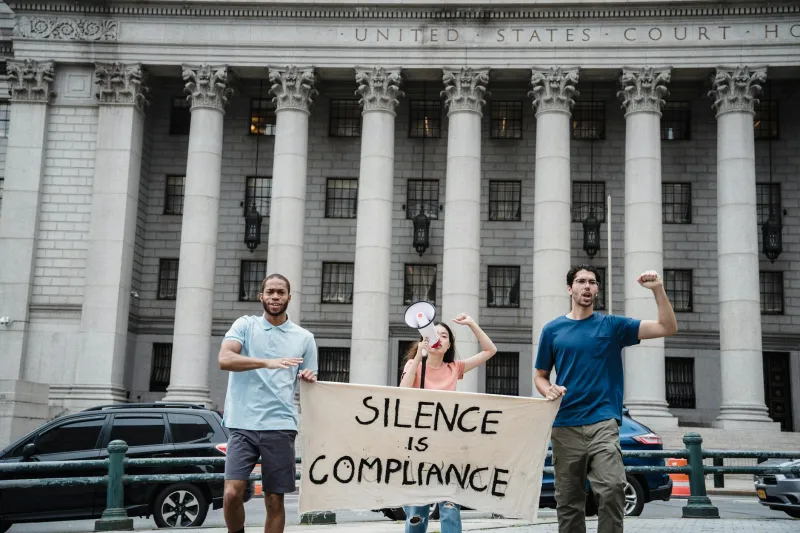
The Democracy Paradox Lives in Every Generation
The Athenian ekklesia prided itself on free debate until Socrates began asking questions that made the wrong people uncomfortable. The Roman Republic celebrated its tradition of senatorial discourse until Caesar's populist appeals threatened the established order. The American experiment enshrined free speech in its First Amendment, then passed the Alien and Sedition Acts seven years later when political opposition became inconveniently effective.
This pattern repeats with mathematical precision across centuries and continents because human psychology remains constant. Those who hold power will always discover that protecting dissent sounds noble in theory but feels dangerous in practice. The machinery they construct to silence today's troublemakers becomes tomorrow's inheritance, ready for new hands to operate.
The Elastic Definition of Dangerous Speech
What constitutes "dangerous" speech expands and contracts like a political accordion, always somehow encompassing whoever currently threatens the establishment. In 1798, criticizing President Adams became sedition. During World War I, opposing the draft became espionage. In the 1940s, advocating for worker control of production became conspiracy to overthrow the government. In the 1960s, organizing against segregation became communist subversion.
The specific charges change; the underlying mechanism remains identical. Democratic governments discover they cannot simply ban opposition outright—that would expose the hypocrisy too nakedly. Instead, they develop sophisticated methods for redefining legitimate dissent as criminal activity. The process always follows the same steps: identify the threat, expand existing laws to encompass it, prosecute selectively to create precedent, then normalize the new boundaries of acceptable discourse.
The Institutional Memory of Suppression
Perhaps most tellingly, the legal frameworks created to silence one era's dissidents never disappear. The Espionage Act of 1917, crafted to prosecute anti-war activists, remained on the books to prosecute Daniel Ellsberg in 1971 and Chelsea Manning in 2010. The Smith Act, designed to target 1940s communists, provided the template for prosecuting 1960s civil rights organizers. The RICO Act, intended for organized crime, became a tool against environmental activists and anti-abortion protesters alike.
This institutional memory serves a purpose beyond mere legal convenience. Each generation of power holders inherits not just the machinery of suppression, but the psychological justification for using it. The precedent established by previous administrations provides moral cover: if the founders could silence their critics, if Lincoln could suspend habeas corpus, if Wilson could jail socialists, then surely today's threats justify today's measures.
The Theater of Democratic Tolerance
Democracies maintain their legitimacy through elaborate performances of tolerance. They celebrate dissidents from previous generations—the same ones they once imprisoned or exiled—while systematically marginalizing contemporary voices that pose similar challenges. Martin Luther King Jr. receives a national holiday; Black Lives Matter organizers face federal surveillance. The suffragettes become symbols of democratic progress; modern activists challenging corporate power face domestic terrorism charges.
This theatrical element reveals democracy's most sophisticated suppression mechanism: the ability to co-opt past dissent while criminalizing present resistance. By honoring yesterday's rebels, democratic systems create the illusion of supporting dissent while ensuring that today's rebels understand the price of stepping too far outside acceptable boundaries.
The Loyal Opposition Myth
The concept of "loyal opposition" itself represents democracy's most elegant solution to the dissent problem. By defining legitimate opposition as fundamentally loyal to the system it opposes, democracies create a framework where only toothless criticism qualifies as acceptable discourse. Opposition parties may disagree on policy details, but they must accept the fundamental legitimacy of the system itself.
This framework explains why democratic systems tolerate partisan bickering while harshly suppressing systemic critique. A Republican opposing a Democratic president's policies poses no threat to the underlying power structure; an activist questioning the legitimacy of corporate influence over both parties threatens the entire arrangement. The former receives media coverage and speaking fees; the latter faces investigation and prosecution.
The Eternal Return of Emergency Powers
Every generation witnesses the same cycle: crisis emerges, emergency powers expand, opposition voices face suppression, the crisis passes, but the powers remain. The Sedition Act expired, but its precedent lived on. The Palmer Raids ended, but the deportation machinery remained. McCarthyism faded, but the surveillance apparatus endured. The War on Terror evolved, but the legal frameworks for indefinite detention and mass surveillance became permanent features of American governance.
These emergency powers never truly disappear because they serve a function beyond addressing immediate threats. They normalize the idea that democracy must sometimes suspend its own principles to survive. Each crisis provides an opportunity to expand the definition of acceptable suppression, creating new precedents for future administrations to invoke.
The Record Speaks
Five thousand years of recorded history demonstrate that no democratic system has ever solved this fundamental contradiction between protecting dissent and preserving power. The human psychology that drives this pattern—the instinct to silence threatening voices while maintaining the appearance of tolerance—remains as constant as gravity.
The machinery of suppression, once constructed, never disappears. It simply waits in the legal code, in the bureaucratic procedures, in the institutional memory of how previous generations handled their troublemakers. Each new administration inherits this machinery and discovers, often to their own surprise, how useful it can be when opposition becomes genuinely inconvenient.
The loyal opposition was never supposed to be loyal to democracy's ideals—only to its power structure. Understanding this distinction explains why every democratic system eventually discovers its own throat and learns to squeeze it with such practiced efficiency.