The Line That Started the War: Five Thousand Years of Cartographic Violence
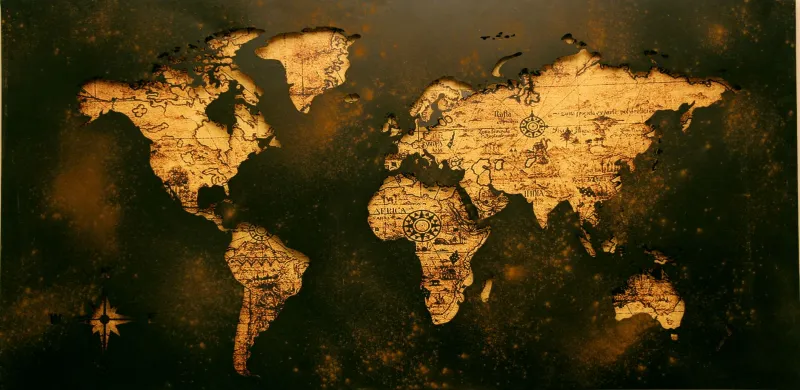
In 1494, two Catholic monarchies divided the entire non-European world between themselves using a line drawn on a map. The Treaty of Tordesillas placed a meridian 370 leagues west of the Cape Verde Islands: everything to the west belonged to Spain, everything to the east to Portugal. The people who actually lived in those territories were not consulted. Many of them had not yet been contacted. The line was, in the most literal sense, drawn across places its authors had never seen, allocating land whose full extent they did not know, among populations whose existence they had only recently confirmed.
 Photo: Cape Verde Islands, via assets.serenity.co.uk
This is not an exceptional moment in the history of cartography. It is a representative one.
Maps as Arguments
The fundamental insight that modern political geography has been slow to absorb — though historians have understood it for decades — is that maps do not describe the world. They argue about it. Every line on every political map represents a claim that someone made, usually at someone else's expense, and froze into apparent permanence through the authority of ink, paper, and institutional backing.
The ancient world understood this intuitively, even without formal cartographic traditions. Egyptian pharaohs erected boundary stelae — inscribed stone markers — not merely to inform travelers that they had crossed a border, but to assert, in the most durable medium available, that the border existed and that Egypt had placed it there. The stele was simultaneously a map, a legal document, and a territorial threat. Remove the stele and the claim weakened. Leave it standing and the claim persisted through administrations, through dynasties, through centuries.
The transition from stone markers to drawn maps did not change the underlying logic. It amplified it. A map could be copied, distributed, carried into diplomatic negotiations, and reproduced in textbooks that would shape the geographic imagination of generations not yet born. A line on a map could do work that an army of stelae could not: it could make a territorial claim feel like a natural fact.
The Cocktail Napkin Empires
The most consequential period of cartographic boundary-making in modern history unfolded during and after the two world wars, when exhausted diplomats divided the remains of collapsed empires with a combination of strategic calculation, ethnic ignorance, and breathtaking speed. The Sykes-Picot Agreement of 1916, in which British and French diplomats divided the Middle East into spheres of influence using a map and a ruler, has become the shorthand reference for this phenomenon — and with good reason. The lines drawn in that negotiation, modified and formalized through subsequent treaties and League of Nations mandates, created the basic political geography of a region that has not known sustained peace since.
What is less frequently noted is that Sykes-Picot was not an aberration. It was a method, applied across multiple continents by multiple imperial powers over several centuries, that consistently produced the same result: borders that reflected the negotiating positions of distant governments rather than the demographic, geographic, or cultural realities of the territories being divided.
The Berlin Conference of 1884-1885, in which European powers formalized their partition of Africa, provides perhaps the starkest illustration. Representatives of fourteen nations divided a continent containing thousands of distinct ethnic and linguistic communities into territories whose boundaries followed lines of latitude, longitude, and colonial convenience. The conference produced a map. The map produced borders. The borders produced, among other things, the conditions for virtually every major African conflict of the twentieth and twenty-first centuries.
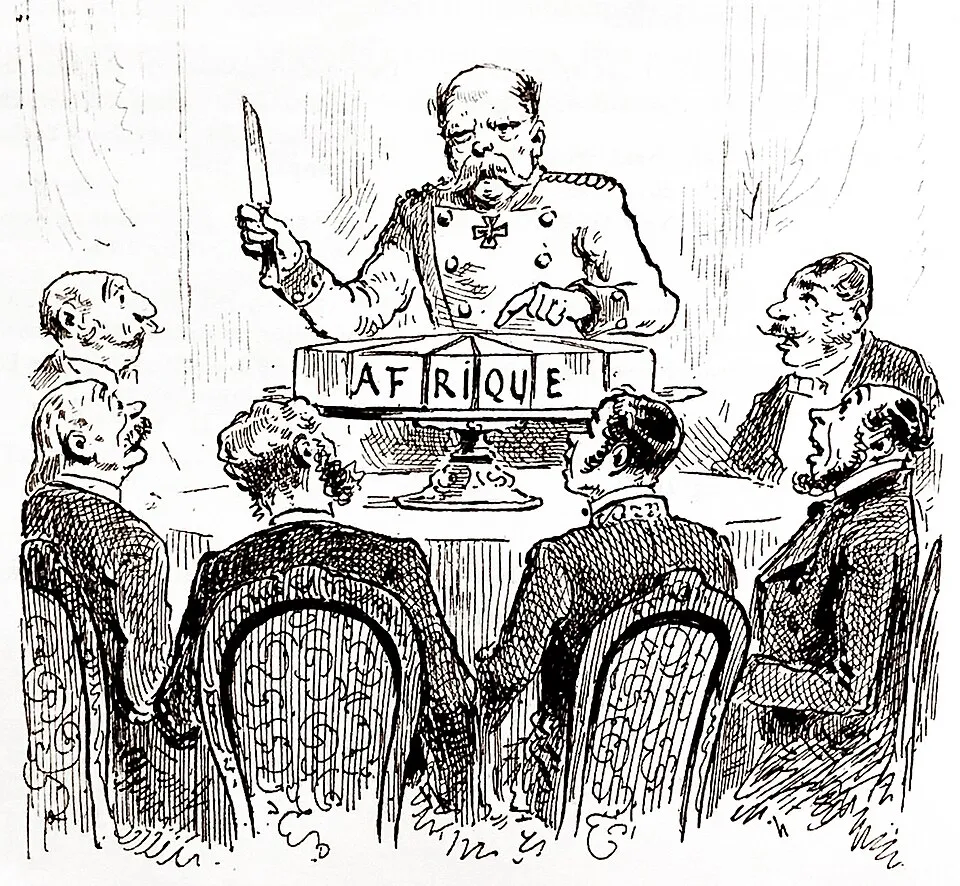 Photo: Berlin Conference, via www.theleftberlin.com
The American Inheritance
Americans have reason to find this history personally relevant, not merely academically interesting. The United States was itself a product of cartographic argument. The boundaries established by the Treaty of Paris in 1783 — which ended the Revolutionary War and defined the new nation's territory — were drawn by negotiators in Paris who were working from maps of varying accuracy, making claims about territories that neither the British nor the Americans fully controlled, and creating boundary descriptions that would generate disputes with Britain, Spain, and Native nations for the next century.
The Louisiana Purchase of 1803 doubled the nation's territory through a transaction that was, at its core, a cartographic claim: Napoleon sold boundaries that France had never fully surveyed, to a government that had never fully explored them, for a price that neither party could fully justify, producing a legal description of territory whose actual extent remained genuinely uncertain for years afterward. The purchase was a map before it was a place.
The US-Mexico border, currently the subject of intense domestic political argument, is itself the product of two distinct cartographic moments: the Treaty of Guadalupe Hidalgo in 1848, which transferred roughly half of Mexico's territory to the United States following a war of contested origins, and the Gadsden Purchase of 1853, which adjusted the line to accommodate a proposed railroad route. The communities that lived along that line — many of whom had lived there for generations under Spanish and then Mexican sovereignty — found themselves on one side or the other based on negotiations conducted in Washington and Mexico City by people who had never visited the relevant terrain.
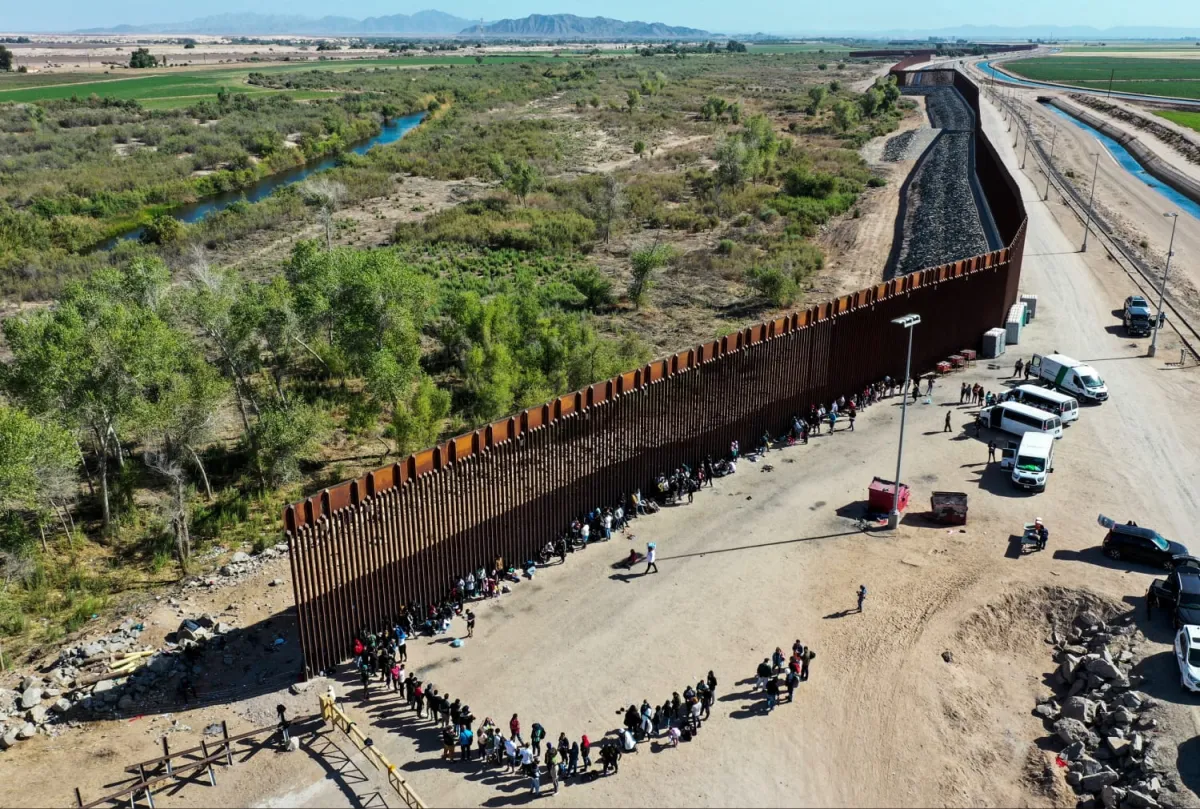 Photo: US-Mexico border, via media-cldnry.s-nbcnews.com
The Surveyor's Unearned Authority
What makes the cartographic production of conflict particularly worth examining through the lens of human psychology is the authority that maps have consistently commanded, across cultures and centuries, far beyond what their accuracy or legitimacy warrants. There is something about a line on paper — particularly a line executed with apparent precision, labeled with official terminology, and reproduced in authoritative publications — that causes human beings to treat it as more real than the landscape it purports to describe.
This is not a modern pathology. The ancient Chinese concept of territory was deeply tied to maps and their symbolic power; emperors commissioned maps not primarily for navigational purposes but to assert, visually and politically, the extent of their domain. Medieval European maps frequently distorted geography in ways that served theological or political arguments, placing Jerusalem at the center of the world not because cartographers believed it was geographically central but because they believed it was spiritually so. The map was always, at some level, a rhetorical document.
The practical consequence of this misplaced authority is that lines drawn in ignorance, in haste, or in service of interests entirely foreign to the affected population acquire a kind of permanence that their origins do not justify. They become, over time, the baseline from which all subsequent claims are measured — the neutral starting point of disputes that are anything but neutral.
Drawing the Next War
The cartographers of the twenty-first century are not working with paper and ink. They are working with satellite imagery, geographic information systems, and digital tools of extraordinary precision. The precision, however, does not resolve the underlying problem. A border drawn with perfect technical accuracy still represents an argument. The argument still has winners and losers. The losers still remember.
The boundaries currently generating the most acute international tensions — in the South China Sea, along the Russia-Ukraine frontier, across the disputed territories of the Middle East — are all, at their core, cartographic arguments that have outlasted the political contexts that produced them. The maps that were drawn to settle those arguments instead preserved them, encoding the unresolved claims of one era into the starting conditions of the next.
Five thousand years of evidence suggests this is not a solvable problem so much as a permanent feature of the way human beings organize territory and the conflicts that territory produces. The line will always be drawn. Someone will always draw it wrong. And the people who live on the wrong side of it will remember, long after the cartographer has been forgotten.