The Last Interpreter: How the Power to Read the Law Became the Power to Write It
The Document Always Runs Out
The architects of written law have always believed, with sincere conviction, that sufficient precision could eliminate interpretive discretion. The Babylonian scribes who compiled Hammurabi's code around 1754 BCE inscribed nearly three hundred provisions onto a basalt stele — specific, detailed, covering commercial disputes, property rights, and criminal penalties with what must have seemed like exhaustive thoroughness. Within a generation, there were situations the code had not anticipated. Someone had to decide what the code would have said if it had.
 Photo: Hammurabi's code, via i.pinimg.com
That someone was never chosen randomly. The power to resolve legal ambiguity — to declare authoritatively what the law means when the law is silent — is among the most consequential forms of political power that any society can confer. It is also, in virtually every civilization that has created an institution to exercise it, among the most carefully disguised.
The disguise changes. The power does not.
Priests, Calendars, and the Original Judicial Politics
In the Roman Republic, the most consequential legal power was not held by the Senate, the consuls, or the popular assemblies. It was held by the College of Pontiffs — a body of priests whose religious responsibilities included the maintenance of the official calendar. This was not a trivial administrative function. Roman law specified that certain legal proceedings could only occur on particular days, and those days were not publicly posted. The pontiffs knew which days were legally active and which were not. Litigants, creditors, and debtors had to consult the priests to determine when they could act.
 Photo: College of Pontiffs, via static.wikia.nocookie.net
The parallels to modern procedural law are not incidental. Control over when the law operates is functionally inseparable from control over how it operates. When the Pontifex Maximus determined that a given day was nefastus — legally inactive — he was not merely maintaining a religious calendar. He was deciding who could sue whom, and when. This is interpretation in its most elemental form: the official determination of what the rules permit.
The pontiffs were eventually forced to publish the calendar, around 304 BCE, under pressure from the plebeian politician Gnaeus Flavius. What followed was not the democratization of legal knowledge that reformers had anticipated. The priests simply moved their interpretive monopoly elsewhere — to the rules governing legal formulas, procedural requirements, and ritual exactitudes that laypeople could not navigate without expert guidance. The institution adapted. The power survived.
The Lord Chancellor's Conscience
England's contribution to this pattern is the Court of Chancery, whose history between roughly the fourteenth and nineteenth centuries offers one of the most instructive case studies in judicial power accumulation available to the historical record. The common law courts, by the late medieval period, had become rigid to the point of injustice — bound by precedent and procedural formalism in ways that could produce outcomes that were technically legal and substantively absurd. Petitioners who could find no remedy at common law began appealing directly to the king, and the king delegated those appeals to his Lord Chancellor.
 Photo: Court of Chancery, via courts.delaware.gov
The Chancellor's jurisdiction was explicitly described as the realm of "equity" — fairness, conscience, the correction of outcomes that law produced but justice could not endorse. It was, by design, a discretionary power. The Chancellor would consider what was equitable in the particular circumstances before him and decide accordingly.
The seventeenth-century jurist John Selden described the result with an acidity that has not diminished: "Equity is a roguish thing. For law we have a measure... equity is according to the conscience of him that is Chancellor, and as that is larger or narrower, so is equity." One Chancellor had a long foot, Selden observed, and another a short one. The measure of justice was the anatomy of the judge.
By the time Parliament finally merged the equity and common law courts in the 1870s, Chancery had developed its own elaborate body of precedent, its own procedural rigidities, and its own institutional interests — the very pathologies it had been created to cure.
The Robe as Camouflage
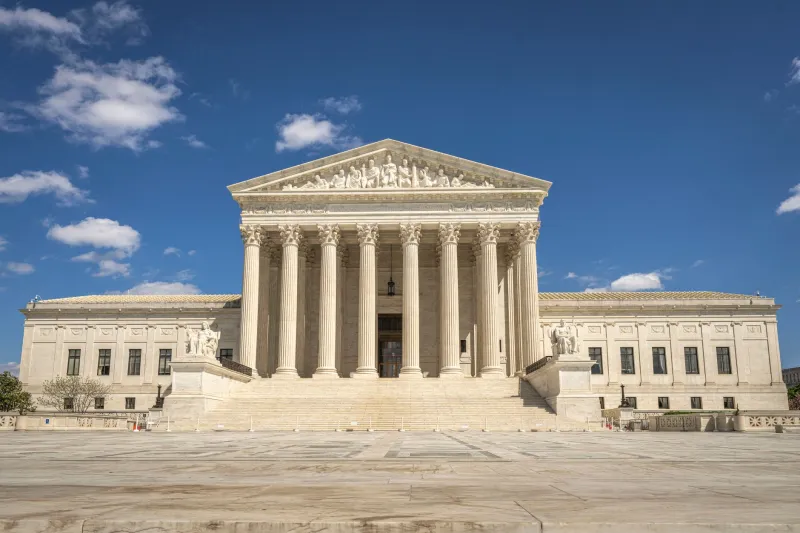
The Supreme Court of the United States is, for most Americans, the beginning of this story rather than its latest chapter. It should be understood as the latter. The institution's authority to strike down acts of Congress — judicial review, as established in practice by Chief Justice John Marshall's 1803 decision in Marbury v. Madison — is not explicitly granted by the Constitution. Marshall's opinion is, among other things, a demonstration that the power to interpret the document includes the power to locate within it authorities the document did not explicitly enumerate.
This is not a criticism unique to Marshall or to the Court he shaped. It is a structural observation that applies to every equivalent institution in the historical record. When a society creates a body to authoritatively resolve legal ambiguity, it necessarily grants that body the power to define the scope of its own authority. The Roman pontiffs determined which questions were religious and therefore theirs to answer. The Lord Chancellors determined which cases implicated conscience and therefore warranted equitable intervention. The Supreme Court determines which constitutional questions are justiciable and therefore within its jurisdiction.
The institution that decides what the rules mean also decides, inevitably, what the rules are.
The Costume of Neutrality
What distinguishes judicial power from other forms of political power is not its substance but its presentation. Legislators openly advocate for outcomes. Executives openly pursue agendas. Judges are institutionally required to describe their decisions as discoveries — findings of what the law already said, not choices about what the law should say. The robe, the formal opinion, the citation to precedent: these are not merely ceremonial. They are the apparatus through which political decisions are translated into legal conclusions.
This translation is not fraudulent in the crude sense. Judges genuinely believe, in most cases, that they are reading rather than writing. The human capacity for motivated reasoning — extensively documented in both the psychological literature and the five-thousand-year record of human behavior — does not require conscious bad faith. A judge whose prior beliefs, cultural formation, and political sympathies incline toward a particular outcome will find, with sincere conviction, that the law supports that outcome. The sincerity is real. The neutrality is not.
American debates about judicial appointments have grown, in recent decades, into the most visible and contentious confirmation processes in the democratic world. This is not a symptom of political dysfunction. It is a symptom of political clarity. The participants in those battles understand, with the intuitive accuracy that historical patterns reward, that the interpreter of last resort is not a referee. They are a player. They always have been.