The Document as Dagger: How Republics Die by Their Own Founding Words

There is a particular kind of political violence that leaves no visible wound. No armies march. No buildings burn. The courts remain open, the legislature convenes on schedule, and the founding document sits under glass, undisturbed, as the republic it was designed to protect is methodically hollowed out by the very people quoting it most loudly.
This is not a modern innovation. It is one of the oldest patterns in the record of human governance, and understanding it requires abandoning the comfortable assumption that a written constitution is, by itself, a safeguard against tyranny.
The Senate's Ancient Trick
When the Roman Senate invoked the senatus consultum ultimum — the emergency decree that suspended normal legal protections — it did so with the full apparatus of republican legitimacy. Senators wore their togas. The proper forms were observed. The language of the founding tradition was deployed with meticulous care. What the Senate was actually doing, in 88 BC and again in the decades that followed, was using the architecture of republican law to eliminate republican opponents.
 Photo: Roman Senate, via thumbs.dreamstime.com
Sulla did not abolish the Roman constitution. He cited it. He pointed to precedent, to ancient custom, to the technical requirements of the law, and used each citation as a step toward a form of power the constitution's authors would have found unrecognizable. The document survived. The republic did not.
The lesson Rome offers is not that constitutions are useless. It is that constitutions are only as durable as the shared understanding of their purpose among those empowered to interpret them. Once a sufficiently powerful faction decides that winning matters more than the spirit of the law, the letter of the law becomes a toolkit for dismantling everything the spirit was meant to build.
The Lawyer's Advantage
Bad-faith constitutionalism has always required a particular kind of practitioner: someone who has studied the founding document closely enough to find its pressure points. This is not the work of outsiders. Outsiders rarely have the access or the expertise. The most effective constitutional subversion in history has consistently been carried out by insiders — men and women who attended the right academies, argued in the right courts, and learned exactly which procedural levers, when pulled in the right sequence, could produce outcomes the founders never intended.
The Weimar Republic's collapse offers perhaps the most studied example. The legal mechanisms that brought Adolf Hitler to power in January 1933 were, in a technical sense, constitutional. Article 48, which granted emergency powers to the Reich President, had been used dozens of times before the Nazi era. The Enabling Act of March 1933, which transferred legislative authority to Hitler's cabinet, passed with the required two-thirds majority, achieved partly through intimidation and partly through the absence of Communist deputies who had been arrested. Every step had a legal citation. Every citation was, in some narrow procedural sense, defensible.
 Photo: Weimar Republic, via www.thalo.com
The Weimar constitution was not defeated by people who ignored it. It was defeated by people who understood it better than its defenders did.
America's Recurring Stress Test
The United States Constitution has survived more than two centuries, which by historical standards makes it an extraordinary document. But longevity is not immunity. The American constitutional tradition has faced repeated episodes in which its language was invoked in direct opposition to its purpose — and the outcomes of those episodes have varied considerably.
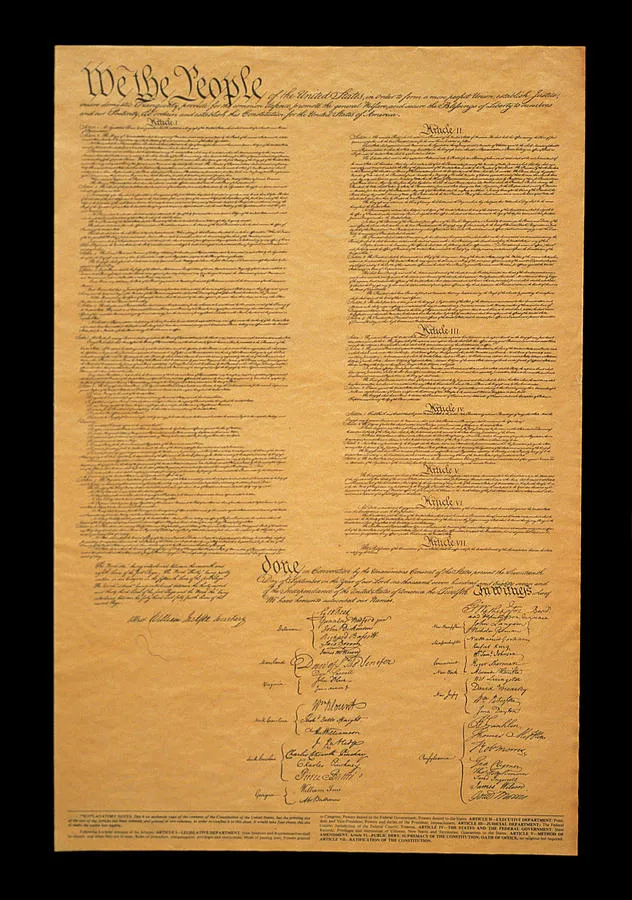 Photo: United States Constitution, via images.fineartamerica.com
The antebellum South constructed an elaborate constitutional argument for the preservation of slavery, citing property rights, states' sovereignty, and the specific compromises embedded in the original text. These were not legally frivolous arguments. Some of the most technically accomplished legal minds of the era made them. The fact that the argument was ultimately defeated — at enormous cost — does not erase the fact that the Constitution's own language was the primary weapon employed in its defense.
More recently, debates over executive authority, emergency declarations, the scope of the Commerce Clause, and the boundaries of judicial review have all featured sophisticated constitutional arguments deployed in service of outcomes that would have puzzled or alarmed the document's authors. This is not unique to any single political party or era. It is a structural feature of any system in which a written document serves simultaneously as supreme law and as the primary arena of political contestation.
Rigidity as Vulnerability
Constitutions derive much of their power from their resistance to easy amendment. A document that can be rewritten whenever a political majority finds it inconvenient offers little protection against that majority's worst impulses. The very rigidity that makes a constitution authoritative is what makes it worth capturing.
Once a faction controls the institutions empowered to interpret the founding document — courts, legislative committees, executive agencies — the document itself becomes a force multiplier for that faction's agenda. Its language can be stretched, its silences filled, its ambiguities resolved consistently in one direction, until the living practice of constitutional governance bears only a ceremonial resemblance to the text being cited.
Historians of ancient Athens have noted a similar dynamic in the manipulation of the graphe paranomon, a legal procedure theoretically designed to protect the constitution from illegal proposals, which was routinely weaponized by political factions to neutralize opponents through procedural harassment. The tool of constitutional protection became the instrument of constitutional abuse.
What the Record Suggests
Five thousand years of political history offer no reliable method for making a founding document proof against bad-faith interpretation. What the record does suggest is that the durability of constitutional governance correlates less with the sophistication of the document than with the breadth of the coalition committed to its spirit rather than merely its letter.
Republics have survived constitutional stress when a sufficient number of their citizens — not just their lawyers — understood what the document was for and were willing to defend that purpose even when the procedural argument ran the other way. They have failed when constitutional literacy became the exclusive property of those with the most to gain from its manipulation.
The uncomfortable implication for any democracy is that constitutional education is not a civic amenity. It is a survival requirement. A republic whose citizens cannot distinguish between the letter of their founding document and its animating purpose has already handed its enemies the only weapon they will ever need.