Erasing Yesterday: The Authoritarian's Guide to Manufacturing Tomorrow's Truth
The Pharaoh's Chisel
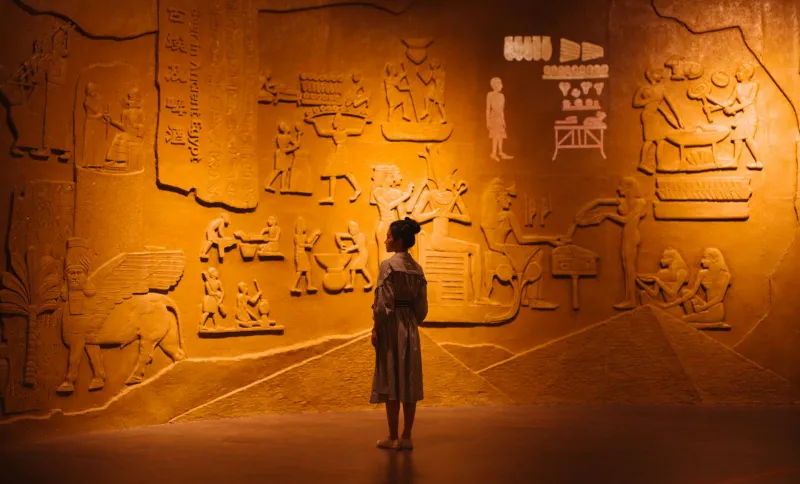
When Hatshepsut died in 1458 BCE, her stepson Thutmose III didn't simply assume power—he began the methodical process of erasing her from history. Stonemasons worked across Egypt, chiseling her name from monuments, defacing her statues, removing her cartouches from temple walls. Within a generation, one of Egypt's most successful pharaohs had been reduced to a historical footnote, remembered only in fragments too small or too hidden for the revisionists to find.
This act of historical vandalism represents humanity's first documented attempt at what we might now call memory management. But Thutmose III wasn't driven by petty revenge—he was implementing a sophisticated understanding of how power actually works. Control the past, and you control the future. Shape what people believe happened yesterday, and you determine what they'll accept tomorrow.
Five thousand years later, the technology has evolved, but the impulse remains identical.
The Textbook Wars
Every successful authoritarian regime discovers the same strategic principle: the classroom is more important than the courtroom. Laws can be overturned, elections can be lost, but beliefs implanted in childhood become the foundation stones of adult reality. This is why the battle over school curricula generates such disproportionate passion—everyone intuitively understands that we're not really arguing about pedagogy.
Soviet encyclopedias became notorious for their creative relationship with historical facts. Fallen leaders didn't just lose power; they disappeared from photographs, vanished from historical accounts, ceased to exist in any official sense. The Great Soviet Encyclopedia regularly mailed subscribers replacement pages to paste over entries that had become politically inconvenient. Reality itself became a subscription service, updated as needed to match current party doctrine.
But the Soviets were hardly unique in this approach. Nazi textbooks transformed German history into a racial destiny narrative. Mao's Cultural Revolution didn't just purge people; it purged ideas, replacing traditional Chinese history with revolutionary mythology. Every successful totalitarian movement eventually realizes that controlling information is more effective than controlling people.
The American Exception That Wasn't
American exceptionalism has always included the belief that our decentralized education system provides natural immunity against historical revisionism. Local school boards, state standards, competing textbook publishers—the theory suggests that no single narrative can dominate when authority remains distributed.
Yet this confidence ignores how modern information distribution actually works. A handful of textbook publishers control the majority of American classrooms. State adoption processes create de facto national standards. Digital platforms allow real-time content updates that would have made Soviet encyclopedists weep with envy.
More importantly, the decentralized system creates its own vulnerabilities. When every local school board becomes a battlefield over historical interpretation, the loudest voices often prevail over the most accurate ones. Professional historians find themselves competing with activists who understand that passion trumps expertise in public forums.
The Digital Accelerant
Technology has transformed historical revisionism from a generational project into a real-time operation. Search algorithms determine which version of events people encounter first. Social media platforms amplify certain interpretations while suppressing others. Wikipedia—the de facto encyclopedia for most Americans—can be edited by anyone with sufficient persistence and ideological commitment.
The democratization of information was supposed to make historical manipulation impossible. Instead, it has made historical manipulation effortless. When anyone can publish, and algorithms determine visibility, truth becomes whatever story generates the most engagement. And engagement, as any social media platform will confirm, correlates more strongly with outrage than accuracy.
Digital natives, raised on platforms where information updates constantly and competing narratives coexist simultaneously, develop a fundamentally different relationship with historical truth than previous generations. For them, history isn't a fixed record of what happened; it's a fluid narrative that changes based on who's telling it and why.
The Curriculum as Battlefield
Contemporary battles over American history curricula reveal how the textbook wars have evolved for the digital age. The 1619 Project doesn't simply offer an alternative interpretation of American founding—it proposes a fundamental restructuring of the national origin story. Conservative responses don't simply critique this interpretation—they propose legislation to ban it from classrooms.
Both sides understand what's actually at stake. Historical narratives don't just describe the past; they define the possible futures. If America was founded on slavery and genocide, then contemporary inequalities represent the continuation of original sins that require radical remediation. If America was founded on liberty and opportunity, then contemporary inequalities represent deviations from founding principles that require restoration.
These aren't academic debates; they're competing claims about national legitimacy. The side that wins the textbook wars wins the right to define what America is supposed to become.
The Memory Hole's New Efficiency
Orwell's concept of the memory hole—the mechanism by which inconvenient facts disappear from official history—assumed a centralized bureaucracy with comprehensive control over information. Modern memory holes operate more efficiently through market mechanisms and algorithmic curation.
Search engines don't need commissars to suppress inconvenient information; they simply need algorithms that prioritize recent content over historical records. Social media platforms don't need censors to shape public memory; they need engagement algorithms that reward emotional responses over factual accuracy. The result is a form of historical amnesia that emerges organically from the structure of digital information systems.
This creates what researchers call "the Google effect"—the tendency for people to forget information they believe will remain accessible online. But when that information becomes harder to find, or when alternative versions crowd out original sources, the practical effect resembles traditional censorship while maintaining the appearance of open access.
The Early Warning System
Historical revisionism in education serves as democracy's canary in the coal mine. Societies that tolerate the systematic distortion of historical facts in classrooms rarely maintain their commitment to factual accuracy in other domains. The intellectual habits that accept politically convenient lies about the past prepare citizens to accept politically convenient lies about the present.
This is why authoritarian movements always target education early in their consolidation process. It's not enough to control current information flows; they must also control the framework through which citizens interpret new information. Historical narratives provide that framework, shaping not just what people believe happened, but how they evaluate what's happening now.
The American founders understood this dynamic, which is why they viewed an educated citizenry as essential to republican government. But they assumed education would promote critical thinking rather than ideological conformity. They couldn't have anticipated how modern information systems would transform education from a vaccine against propaganda into a vector for its transmission.
Tomorrow's Truth
The battle for historical memory continues with each generation, but the stakes have never been higher. Digital technologies that were supposed to preserve human knowledge have instead created new opportunities for its manipulation. Educational systems that were designed to promote democratic citizenship have become tools for manufacturing ideological compliance.
The pharaohs had to chisel names off monuments one at a time. Modern revisionists can update millions of textbooks with a software patch. The efficiency gain is remarkable; the democratic cost may be incalculable. When the past becomes infinitely malleable, the future becomes infinitely manipulable. And when tomorrow's citizens learn only yesterday's lies, democracy dies in the classroom long before it dies at the ballot box.